
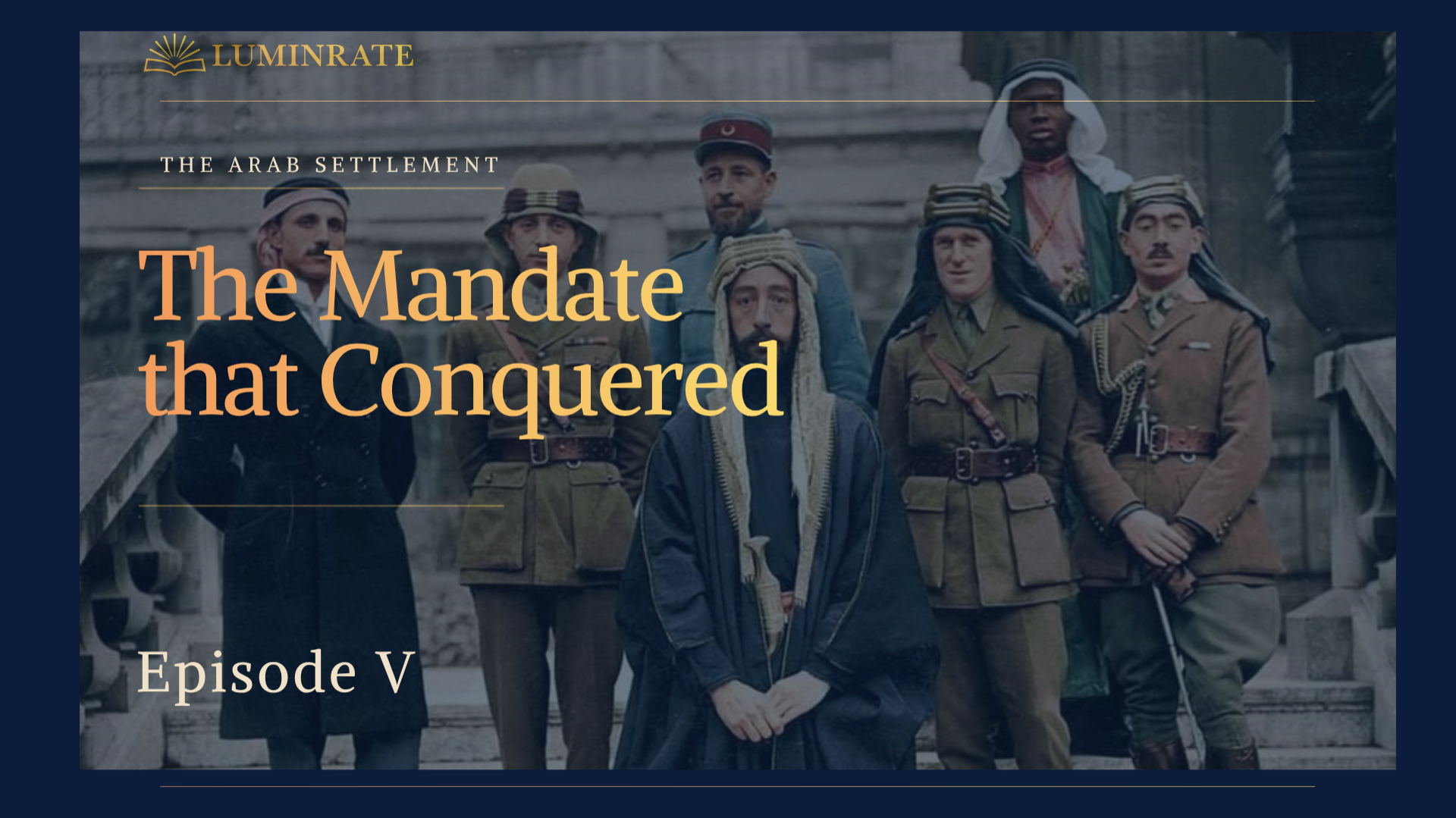
While Arabs fought the Ottomans across the Levant and Arabia for their independence, Britain and France were drafting secret treaties to divide the same lands among themselves. In the deserts of the Hejaz, the Sharif of Mecca rose against Ottoman rule, persuaded by London’s promises of a united Arab kingdom. His son, Faisal, carried that promise into battle, leading the Arab army beside British troops in what they believed was a common war for liberation.
But as the Arab Revolt spread north, an agreement signed in secrecy had already sealed Syria’s fate. In 1916, the Sykes–Picot Agreement drew red and blue lines across the Middle East. It assigned the “blue zone” of Syria and Lebanon to France and the “red zone” of Mesopotamia to Britain. The text pledged to “recognize and protect independent Arab states.” Yet at the same time, it allowed the two powers to set up “direct or indirect administration as they may think fit.” Words of independence and the machinery of control appeared side by side.
When the war turned, Arab and British forces swept through the Levant. On October 1, 1918, Damascus fell. Three days later, Faisal entered the city to the sound of church bells and muezzins, hailed as a liberator. After four centuries under Ottoman rule, Damascus was again in Arab hands. Or so it seemed.
Faisal moved quickly. He formed an Arab government under Ali Rida al-Rikabi, established ministries, and raised the flag flown over Aqaba and Mecca. For the first time in generations, Syrians governed themselves. Yet beneath the triumph lay uncertainty. Britain and France had already divided the former Ottoman provinces into temporary zones: British in the south, French in the west, Arabs in the east. This Occupied Enemy Territory Administration foreshadowed the boundaries to come.
The Arabs knew of these secret arrangements and of the Balfour Declaration, promising a Jewish national home in Palestine. Still, hope persisted. President Woodrow Wilson’s Fourteen Points spoke of self-determination. Syrians believed the blood they shed beside the Allies would earn recognition as a single, independent nation from the hills of Haifa to the shores of Alexandretta. To express that vision, they convened the General Syrian Congress.
On July 2, 1919, delegates from every province gathered in Damascus. Muslims, Christians, and Druze sat side by side, speaking not as Ottomans or sects, but as Syrians. Their resolutions declared:
“We desire the Government of Syria to be a constitutional monarchy based on principles of democratic and broadly decentralized rule, which shall safeguard the rights of minorities, and we wish that Amir Faisal, who has striven so nobly for our liberation and enjoyed our full confidence and trust, be our King.”
It was the first modern proclamation of Syrian unity, lighting a flame of hope across the land. The Congress rejected foreign division and affirmed a single state embracing Lebanon and Palestine. In that moment, the old provinces of the Ottoman world seemed to breathe as one body. The resolutions reached Paris, while an American promise to listen kindled fragile hopes.
In the summer of 1919, an American mission headed by Henry King and Charles Crane arrived to gauge the will of the people. From Rafah to Aleppo and from Christian quarters to Druze mountains, they gathered petitions and testimony. Eighty percent of the petitioners called for a united, independent Syria. If guidance was unavoidable, they preferred an American presence to French rule. The commission stated its purpose plainly:
“To get as accurate and definite information as possible concerning the conditions, the relations, and the desires of all the peoples concerned, in order that President Wilson and the American people may act with full knowledge of the facts.”
Its report recommended against a French mandate and warned that force would be needed to impose it. Yet the report was set aside. By the time the commissioners returned, Wilson’s health had failed. The United States had turned inward, refusing to join the League of Nations or the postwar settlements. The only power capable of balancing Britain and France had left the table.
Faisal still believed justice could be argued into existence. He presented an Arab Memorandum at the Paris Peace Conference, invoking wartime promises and Wilsonian ideals. He spoke of a single Syria, independent but cooperative, modern yet rooted in its heritage. Britain, bound to France, stood aside. France, invoking a “historic mission,” claimed the Levant as its sphere of influence. The United States remained silent.
The contradiction had been clear even earlier. British officer G. M. W. Macdonogh wrote in October 1918, “It is suggested that the best means of achieving this result is through the intervention of President Wilson, whose principles are diametrically opposed to those of the agreement.”
Wilson’s intervention never came. His rhetoric of self-determination dissolved into Europe’s old diplomacy. In the vacuum that followed, promises hardened into allotments.
On March 8, 1920, the Syrian Congress proclaimed Faisal King of Syria and adopted a constitution of its own establishing a democratic, decentralized monarchy. In April 1920, at San Remo, the Allies formalized their division of the Arab East. Britain would hold Iraq and Palestine. France would take Syria and Lebanon. The news hit Damascus like a second invasion. For a brief season, the Kingdom of Syria was real. It refused to surrender. It printed currency, issued stamps, and spoke with dignity.
Then came the French ultimatum. From Beirut, General Henri Gouraud demanded submission. Syria refused. On July 24, French troops advanced toward Damascus. At Maysalun, Minister of War Yusuf al-‘Azma led a small army of volunteers to resist. They were overwhelmed. Al-‘Azma fell in battle. Only days later, Damascus fell. Faisal was exiled. The tricolor replaced the Arab flag. As the Beirut journal Al-Muqtataf observed soon after, “The French entered Damascus as victors, not as reformers.”
France divided the land it had seized into fragments: states for Damascus, Aleppo, the Alawites, and the Druze, plus a separate Greater Lebanon. French authorities believed division would prevent rebellion, but it achieved quite the opposite. In the years to follow, the memory of Maysalun and the broken kingdom forged a deeper unity. Underground networks, exiled officers, and students abroad began to speak not only of independence but also of Syria as a nation.
Unlike Iraq, whose mandate emerged through cooperation, the Syrian mandate began with conquest. Where Iraq’s monarchy negotiated treaties, Syria’s people faced bombardment. The British ruled through councils and signatures; the French ruled through soldiers and decrees. Yet from that forced silence came something permanent.
The ink of Sykes and Picot outlasted the ink of Syria’s own Congress. But in defiance, the foundations of modern Syria were laid. What was lost in sovereignty was gained in identity. The mandate buried a kingdom, but it awakened a nation.
Comments