
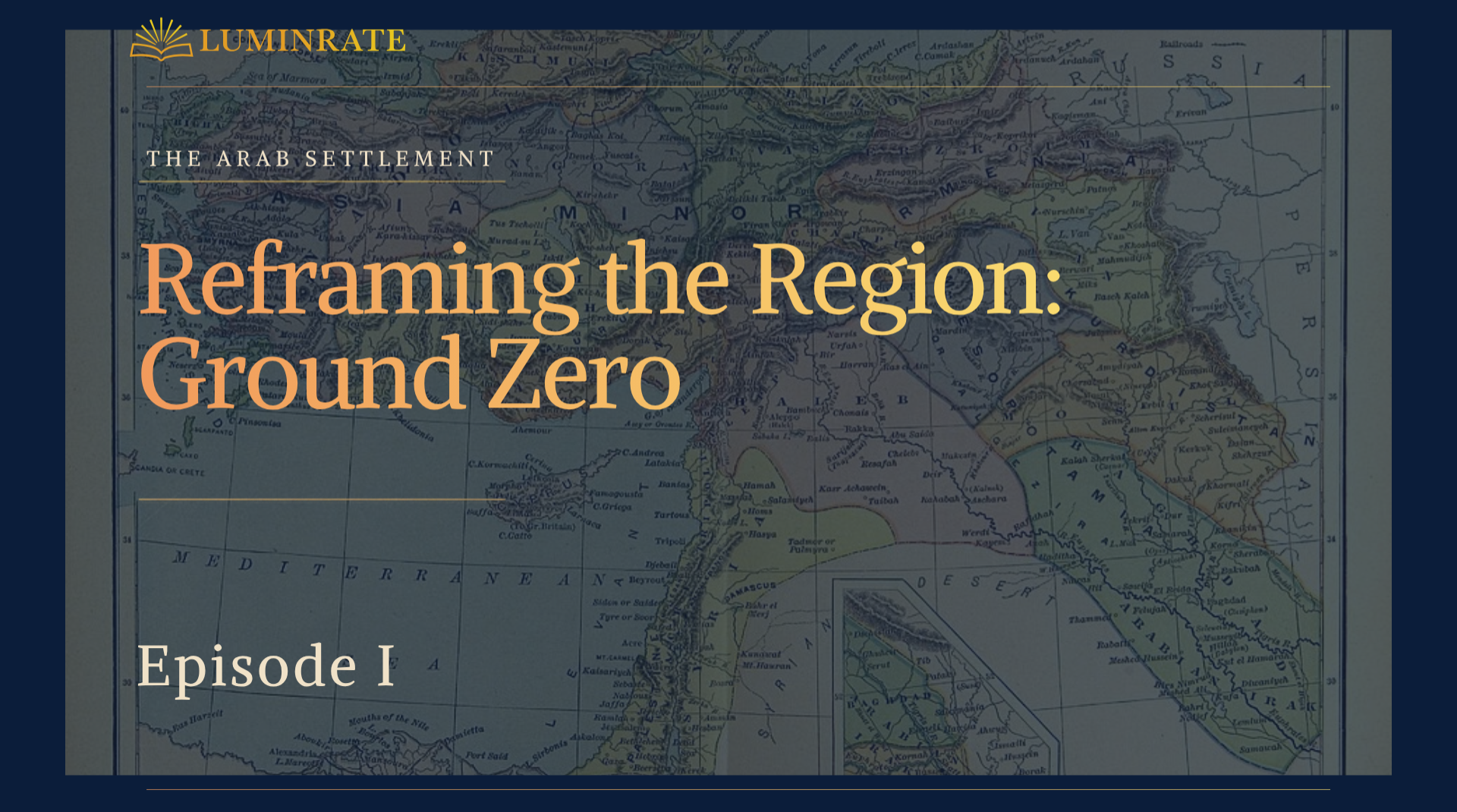
Before the Middle East became the region known today as Iraq, Syria, Lebanon, Jordan, Saudi Arabia, and Palestine, it was part of the Ottoman world. The Ottomans controlled the Middle East not as separate nations but as provinces within their empire, and the political map familiar to us today did not yet exist. Instead, the middle-eastern region was split by districts and local governments whose boundaries shifted over time with local provinces all answering to Istanbul.
For almost half a millennium, a vast majority of the Arab Middle East, from Jerusalem to Bagdad or even Mecca to Damascus, lived (albeit at different times and under different arrangements) under Ottoman rule. The Ottomans governed those regions as districts with governors and bureaucrats, but the Arabs had little to no control over their political and national aspirations. As the centuries went by, the Arab side of the Ottoman Empire became neglected. They remained less developed than other parts of the great empire, while taxation and uneven distribution of imperial resources became the sources of localized criticisms. This matter of fact left parts of the region lacking infrastructure and proper development.
As the 20th century dawned, Arab political and national aspirations were brewing. At the same time, Turkish national aspirations were rising under the reformist Young Turks, whom, after the revolution of 1908, centralized power and hence creating ever-growing tensions over Arab representation and autonomy. Power increasingly saw itself shifting towards Istanbul and the empire’s political identity began tilting in favor of Turkish nationalism. Under control of the Young Turks, the Arabic language was restricted. Arab officials saw themselves getting pushed out of any positions of authority, with their identities and culture diminished.
When World War I began, the Ottomans sided with the Central Powers, making them an enemy of Great Britain. To weaken the Ottomans, Great Britain found an unusual potential ally in certain Arab leaders. In Mecca, Sharif Hussein, the Ottoman Emir of Mecca and an Arab noble, corresponded with British officers, who, under the promise of an independent Arab state, encouraged the Arab Revolt.
The Arab Revolt in 1916 saw major tribes and leaders stand up against Ottoman rule. Be it the Sharif of Mecca, Ibn Saud in Central Arabia, the Iraqis, or Syrian Arabs, all rose against the imperial standards of the Ottomans. Supported financially and armed by Great Britain, the Arab
army, led by Faisal I, gave many lives to the war. By 1918, Faisal's Arab army entered Damascus alongside the British, with whom it had fought throughout the war, arriving on October 1 of that year.
When the war ended and the Ottomans yielded their weapons, the fundamental question became what to do with the Ottoman territories. As victors, the Allies carried the responsibility to manage those territories: Iraq, freed from the Ottomans mainly by British forces, was temporarily placed under their control. The territories that comprise modern-day Syria were given to the Arab army led by Faisal to manage. France, having entered Lebanon during the war, continued to administer that region. Britain had seized Jerusalem, resultingly taking charge of Palestine. All these territories were considered OETA zones (Occupied Enemy Territory Administrations).
As the post-war settlement was brewing, each side wanted different things. The Arabs, having fought for their land, wanted independence above all. France sought the Levant on historical grounds, whilst England, looking to honor its word, still coveted a piece of the pie that had been exclusively Ottoman in the past. At the same time, the Zionist movement in Europe wanted to claim Palestine as its national home.
To reconcile these competing visions, the Allies created the King–Crane Commission, tasked with finding out what the local populations wanted across the Levant. The results were clear: most people across greater Syria wanted a constitutional monarchy and rejected partitioning Palestine for a Jewish homeland. Yet the report was buried and ignored by the great powers.
The peace conference, led by France and England, favored their positions and were skeptical in regard to the Arabs, whom they deemed not ready for self-rule. This idea gave rise to the mandate system; the framework where Arab territories would be administered by Allied powers to supposedly prepare them for statehood. In some cases, such as Iraq and Jordan, this took the form of local governments under foreign leadership.
The mandate system, vague in shape and form, was not practiced equally. For example, Syria was placed under French rule. At the time, the former already had an established monarchy under Faisal I, which had to be abolished. France ruled by invoking historical claims to the region. It was a revival of its Crusader legacy, mixed with a modern ambition to control the Mediterranean.
On the other hand, England wanted a silent empire. It preferred local governments that appeared independent but relied on Britain for their every move, allowing the cost of administration to remain low while the strategic benefits and rewards stayed high.
In Palestine, the British administered the region to facilitate Jewish immigration, whilst in Iraq, they established a monarchy under Faisal I but retained ultimate power through a treaty of their own creation.
The division of former Ottoman territories gave rise to the modern states of the Middle East. The borders we know today were not inevitable, but rather served as the results of foreign ambitions, resistance, historical claims, and decisions made in the span of a few years.
The following series dives into those turning points: the Arab Revolt, the promise of independence, the secret agreements, the mandate system, and the internal and external forces that built the Middle East we know today.
Comments