
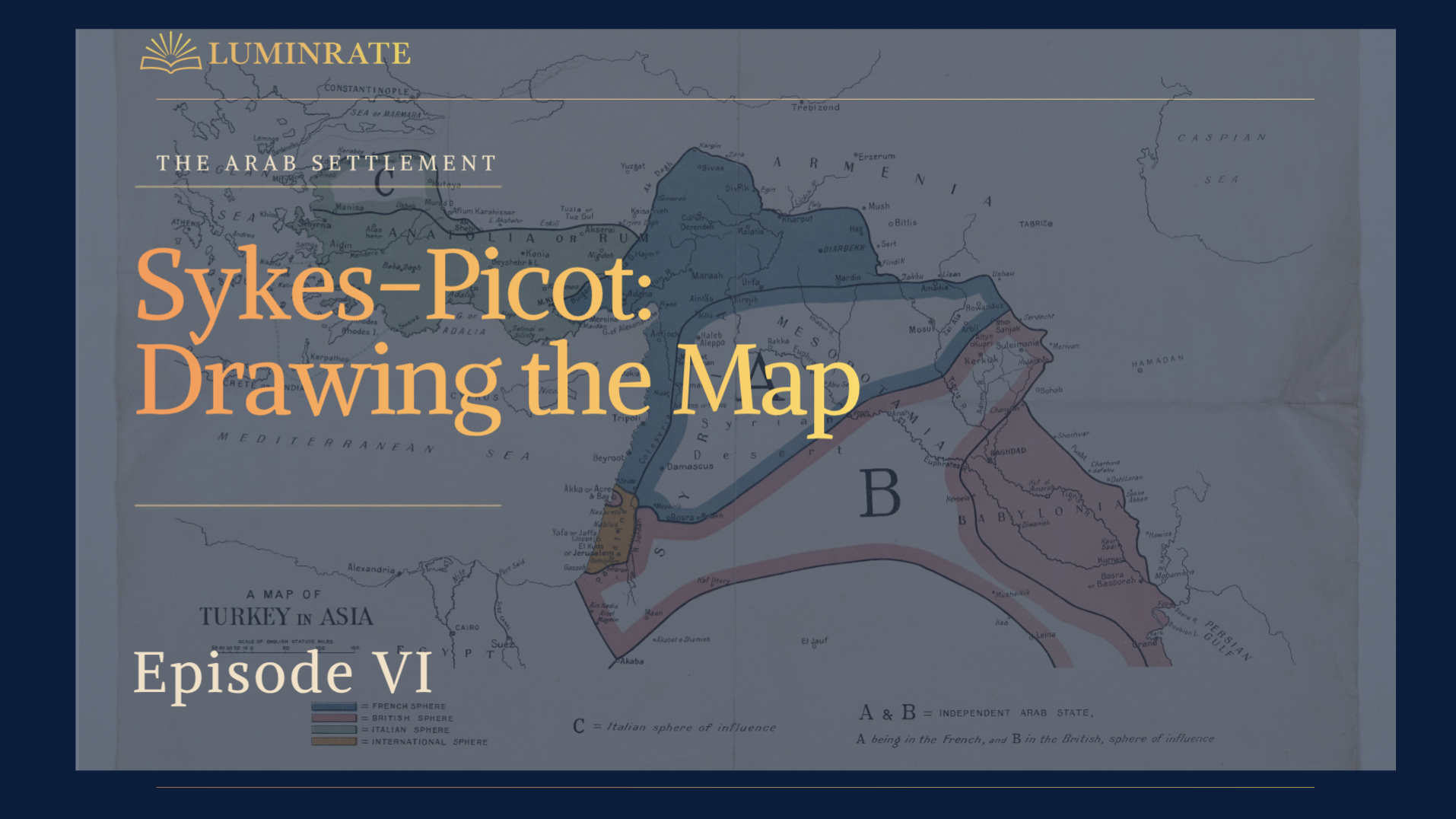
The Sykes-Picot Agreement, signed over a hundred years ago, in May 1916, bears significant responsibility for shaping the modern Middle East as we know it today.
As World War I raged across Europe and the Middle East, the Sykes-Picot Agreement was being drafted. The agreement saw the map of the Middle East redrawn by red and blue lines demarcating the zones of influence of Great Britain and France over territories formerly belonging to the Ottoman Empire. Behind those colored lines lay the first blueprints of a divided Arab world.
The agreement stated the following:
“That France and Great Britain are prepared to recognize and protect an independent Arab state or a confederation of Arab states (a) and (b) marked on the annexed map, under the suzerainty of an Arab chief. That in area (a) France, and in area (b) Great Britain, shall have priority of right of enterprise and local loans. That in area (a) France, and in area (b) Great Britain, shall alone supply advisers or foreign functionaries at the request of the Arab state or confederation of Arab states. That in the blue area France, and in the red area Great Britain, shall be allowed to establish such direct or indirect administration or control as they desire and as they may think fit to arrange with the Arab state or confederation of Arab states.”
The agreement did more than just divide territories; it entrenched British and French authority in the region. Britain and France secured exclusive rights to strategic ports like Haifa and Alexandretta, ensuring economic dominance. They also arranged to avoid tariffs between their zones and claimed control of key railways to maintain their influence.
Upon its drafting, the agreement remained secret between the two powers. Britain and France kept the treaty secret even as their Arab allies fought to free the same lands now marked for partition. The Arabs kept fighting for their lands, while British and French leaders fought for control of those very lands.
As the war came to an end, contrary to British expectations, the Arabs played a more dominant role in the Ottoman campaign than France did. By the time the war was entirely over, the world looked down in disdain at secret treaties, of which the Sykes-Picot Agreement was one.
Not only did the world disfavor secret treaties, but the principle of self-determination became a prominent topic and ideology at the end of the war. This sentiment was championed by no other than President Wilson, who, in his famous Fourteen Points address, said:
“A free, open-minded, and absolutely impartial adjustment of all colonial claims, based upon a strict observance of the principle that in determining all such questions of sovereignty the interests of the populations concerned must have equal weight with the equitable claims of the government whose title is to be determined.” To the Arabs, Wilson’s words sounded like the undoing of Sykes-Picot, a promise that peoples could choose their own fate.
Such statements by Wilson were received in the Arab territories as a breath of fresh air, promising a brighter tomorrow. The case against the Sykes-Picot Agreement was not merely an external protest led by the Arabs and supported by President Wilson. The contradictions within the agreement were clear even to London itself. British officer G. M. W. Macdonogh wrote in October 1918:
“Every one of these circumstances has militated against the usefulness of the Sykes–Picot Agreement. The Arab Revolt and the Anglo-Arab conquest of Syria converted an academic exercise into a treaty fraught with the gravest practical consequences… The Eastern Committee has recognized the imperfections and dangers of the Agreement and has sought some means of cancelling it.”
Yet those warnings did not stop the agreement from shaping the map.
Amidst the darkness represented by the agreement, President Wilson’s rhetoric offered a new glimmer of hope. Wilson’s principles seemed to offer an escape from the secret map of 1916. As Officer Macdonogh wrote:
“It is suggested that the best means of achieving this result [of abandoning the Sykes-Picot Agreement] is through the intervention of President Wilson, whose principles are diametrically opposed to those of the agreement.”
The inner contradictions within the agreement remained behind closed doors. The postwar mandates would largely follow the secret map of 1916. Iraq came under British control, Syria under French control, Palestine under British Control, and a semi-independent state in Jordan
was created. At the same time, Great Britain kept a sliver of its promise and recognized Sharif Hussein’s Kingdom of the Hejaz.
As the San Remo Conference approached, the British still worked under the legacy of Sykes-Picot, aiming to manage spheres of influence and the rising tensions in the O.E.T.A. regions, especially O.E.T.A. East, which encompassed much of inland Syria.
The Arabs, who had committed themselves to removing the Ottomans from power and sacrificed many lives, believed they had earned self-determination. Yet the realities on the ground favored enforcing the Sykes-Picot Agreement rather than granting full sovereignty.
Colonel Joyce, reporting from Syria in August 1919, wrote:
“The actual result of nine months [of] Arab Administration is certainly open to criticism, and it is evident that without outside assistant, the country is not sufficiently advanced for self-government.”
Joyce tempered his criticism, adding:
“It must be borne in mind that this is the first effort of a young nation to manage their own affairs, whose only school of instruction has been corrupt Turkish government.”
While Britain struggled to reconcile its promises to the Arabs with its obligations to France, France pursued an aggressive campaign, asserting its right over the Levant. Colonel Joyce observed:
“In the meantime, French propaganda and statements in the press, whether official or otherwise, are most misleading and convey the impression that France possesses the undisputed right of being appointed mandatory power for Syria and the Lebanon.”
The mandate itself was not a new idea, but Arab hopes for technical and economic assistance and their deep mistrust of the French fueled tensions, thus stirring opposition to colonial rule across the population.
By the time the San Remo Conference took place in April 1920, the United States had retreated from the postwar settlement. This gave France and Great Britain greater freedom to implement their 1916 agreement, despite its contradictions with Britain’s wartime promises.
Iraq, having more experienced officials and officers, was able to gain a degree of local sovereignty as the British took control. By contrast, Syria, mistrustful of the French, resisted the mandate. In Palestine, where the mandate built on two promises, the seeds of a century-long conflict were already sown.
Comments