
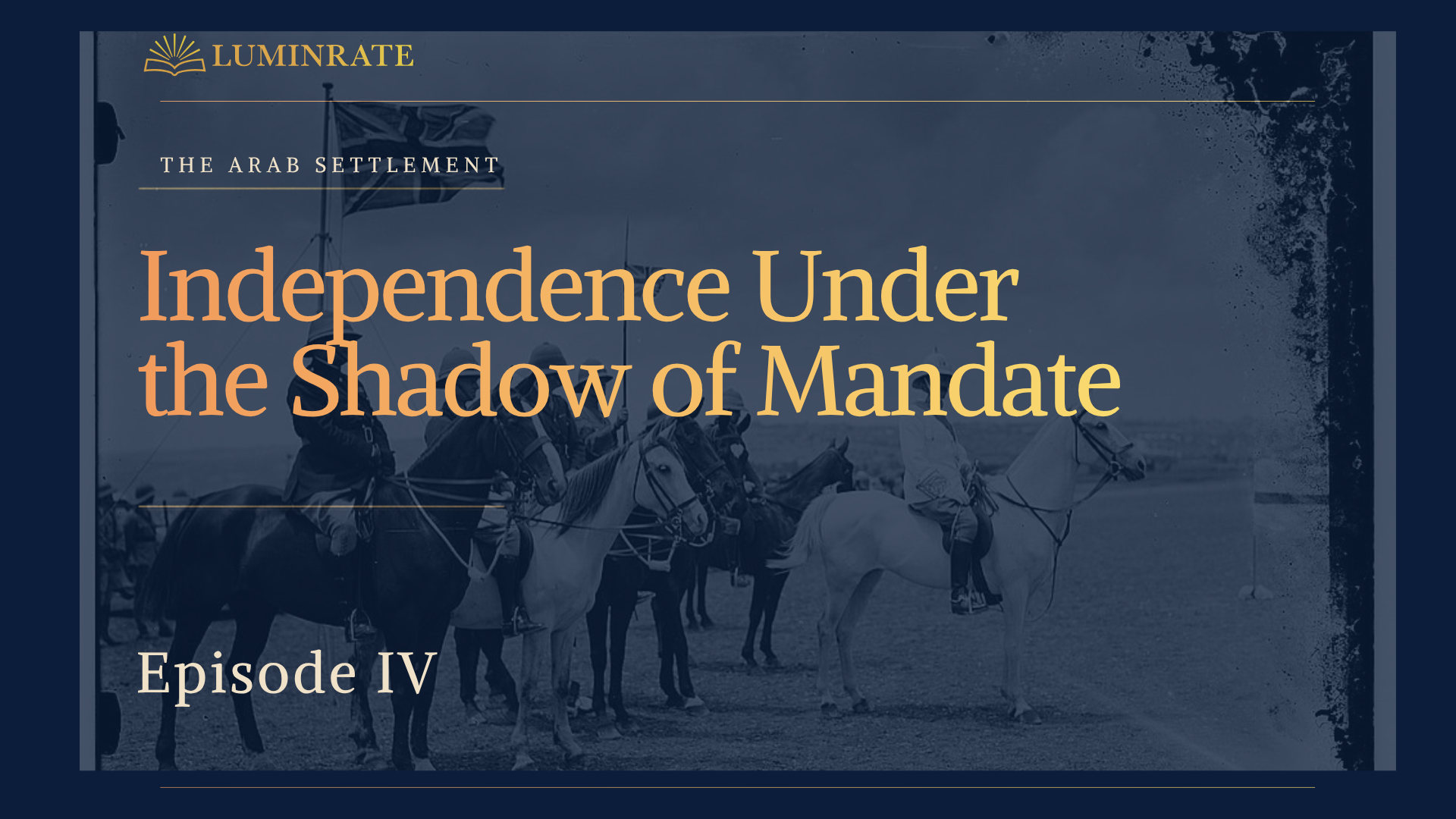
As the post–World War I era dawned, the map of the Middle East was being redrawn. Nowhere did that change feel more dramatic than in Mesopotamia, modern-day Iraq. For the first time in nearly a millennium, the land between the Tigris and the Euphrates was free from Ottoman rule. But freedom did not mean stability nor unity. Iraq was a nation newly born, learning to walk on uncertain ground.
During the war, British forces had expelled the Ottomans from Basra and Baghdad by 1917 and taken Mosul in 1918. Britain administered the territories through a military occupation that soon evolved into a civil government, promising self-rule once the country was ready.
When the League of Nations established the mandate system in 1919, Mesopotamia was assigned to Britain. Article 22 called for the guidance of peoples “not yet able to stand by themselves.” In practice, this meant Britain would build the machinery of a state. An Englishman named Sir Percy Cox would stand at its center. As High Commissioner of Mesopotamia, Cox ruled through diplomacy rather than force. He blended authority with the promise of guidance. His mission was to lead this toddler of a nation into statehood.
Cox’s task was immense: to unify three regions divided by religion, tribe, and history, and to transform Ottoman provinces into an Iraqi nation. Yet resentment brewed. By 1920, anti-British sentiment ignited across the country. The uprising that followed, the 1920 Revolt, was fierce enough to make London rethink its policy. Direct rule had failed; a new arrangement was needed.
In the revolt’s aftermath, Cox’s task was not only to restore order but to rebuild trust. He toured the provinces, meeting tribal leaders, clerics, and former Ottoman bureaucrats, seeking those with experience to help shape the future administration. Out of these meetings would emerge the Provisional Council, the nucleus of what would later become the Council of State.
A figure of immense religious and moral prestige, the Naqib of Baghdad was chosen as the council’s president. Cox said in a report recalling his recruitment to the Naqib, “I asked him to undertake the formation of a Cabinet in the interests of his country.” It was both an invitation and a conviction: that Iraq could only be built by Iraqis themselves, guided but not governed by Britain.
The answer to the political question came through compromise. Iraq would become a kingdom, nominally independent but bound by treaty. Britain would withdraw its soldiers and replace them with advisers. And to lead this fragile experiment, London chose Faisal ibn Hussain, the Hashemite prince who had fought alongside the Allies in Arabia and briefly ruled Syria before being ousted by the French.
When Faisal arrived in Baghdad in the summer of 1921, he inherited a provisional council already shaped by Percy Cox. The Naqib of Baghdad presided as president of the Council of State. Sassoon Effendi Haskail, a leader of the Jewish community, managed the finances and, as Cox once wrote, “commands universal respect and confidence.” Ministries of justice, commerce, and the interior were filled with other respected Iraqis, each paired with a British adviser. To prepare Iraq for statehood, Cox had to shift the role of British officials to an advisory one. He was careful: Iraqis took the titles, but the British retained the levers.
The council’s priority was to craft a civil administration, a judicial system, and a national army. Arab officers trained under the Ottomans were recalled to service. Still, Cox kept the army’s budget under London’s control through the Imperial Exchequer. Iraq could raise its own flag, but its purse strings remained British.
Even as the nation took shape, new threats pressed in from every direction. In the south, the notables of Basra, led by the Sheikh of Muhamarah, petitioned for British protection and separate status from Baghdad. Some in the south even sent telegrams to King Hussain of the Hejaz. They urged him to send one of his sons to rule Iraq.
When Cox departed for the Cairo Conference of 1921, where British officials discussed a unified Middle East policy to ease the strain on the British treasury, Saiyid Talib Pasha used the High Commissioner’s absence to court tribal support. By the time Cox returned, Talib was threatening a revolt “with twenty thousand tribesmen.” Cox responded swiftly: Talib was arrested and exiled to Sri Lanka, his movement dissolved before it could ignite.
To the west, new instability followed the fall of Ibn Rashid’s emirate in 1921. The defeated Shammar tribes sought refuge in Iraq, sparking raids and counter-raids with Ibn Saud’s forces along the desert frontier. Faisal’s young government could not afford another conflict. Cox stepped in once more as mediator. Ibn Saud apologized, claiming ignorance, and accepted a provisional border. This calmed the frontier and resolved the Shammar refugee crisis.
From the north, Turkey’s new republic refused to abandon its claim to Mosul. Through 1921 and 1922, Turkish agents spread propaganda among Kurdish tribes and staged minor hostilities to test Iraq’s defenses. Cox reported these moves to London as proof that Iraq still needed British support.
Within Iraq, dissent simmered. Shia clerics in Najaf pressed for a theocratic order. Nationalists across the country split into two camps: those demanding immediate independence and autonomy, while benefiting from Britain’s material support, and those favoring gradual autonomy under British tutelage. Divisions reached the Council of State itself. Demonstrations and resignations rippled through Baghdad. That year, Faisal’s brief illness deepened the sense of uncertainty.
At last, on October 10, 1922, the Anglo-Iraqi Treaty was signed. It established Britain’s advisory role and recognized Iraq’s sovereignty under King Faisal I. The treaty satisfied the League of Nations’ mandate requirements without using the word “mandate” at all. It was a diplomatic sleight that allowed both nations to claim success.
Four years after the Ottomans’ collapse, Iraq had a constitutional crown, a council, and the semblance of independence. Yet its foundations were still fragile, its future untested.
Born under the mandate’s shadow, Iraq had taken its first steps toward standing alone. But its story was far from over. The decade ahead would decide whether this kingdom, built from the empire’s ruins and guided by foreign hands, could truly claim a place among the world’s independent nations. And beyond its borders, in Syria and the Levant, another mandate was beginning to shape its own uncertain destiny.
British India Office Records quoted in this article are licensed under the Open Government Licence v2.0.
Comments